

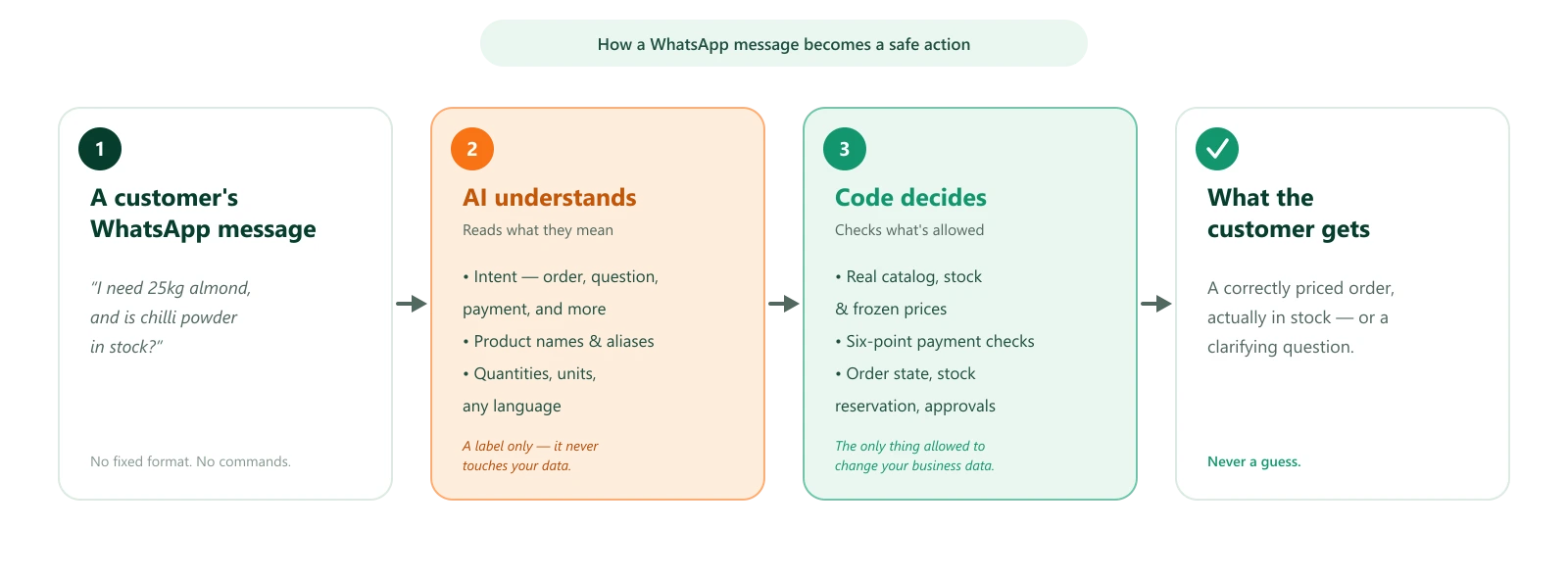
The AI reads messages. It never decides your business.
AI that quietly makes business decisions is a liability. This one is scoped tightly: it turns messy human text and receipt images into a structured label, and every number, price, reply and decision still comes from deterministic code.
It reads how people actually type
English, Tamil, Malay, and romanised mixtures of all three — with no fixed format or command list. Quantities, units and product names are pulled out of ordinary phrasing and matched against your actual catalogue, never a generic dictionary.
- "I need 25kg almond" is read as a product and a quantity, not an unrelated message.
- The same understanding covers mid-conversation corrections — "actually make that 20kg" changes the existing line rather than starting a new one.
It never invents a fact
Every product, price and quantity the AI can reference comes from your own catalogue at the moment of reading — the model is never free to describe something you don't sell or guess at a price. A line it can't confidently match becomes a question with a suggestion, answered by a tap, never a silent best guess.
One open order, built message by message
A first order-shaped message starts a draft; everything after it from the same customer adds to that same order, read against their real order and customer history rather than treated as a fresh conversation each time.
- Not every message is an order — a greeting or a plain acknowledgement is recognised as neither, so a "thanks" doesn't create anything or land on your desk for review.
It knows what's being asked before it decides how to answer
A message is classified into one of a closed set of outcomes — placing or changing an order, a product question, an order-status question, a payment question, a question about the customer's own history, or something that needs a person — never left to guess freely between them.
- "Do you have Almond 25kg?" is recognised as a product question and answered from your catalogue and stock, not treated as an order attempt.
Spent only where it's actually needed
A greeting or a plain acknowledgement — "ok", "thanks", a thumbs up — is recognised before any AI call happens at all, deterministically, so the single most frequent message on the platform costs nothing and adds no delay. AI is reserved for the messages that genuinely need natural-language understanding.
It reads receipts, it doesn't approve them
A photo or PDF receipt is read for amount, reference, date, currency and recipient, then checked against six deterministic rules — duplicate image, duplicate reference, currency, transaction date, amount and recipient account. The AI only ever extracts; it never decides whether a payment is approved. Only the owner's own tap moves money.
Code decides what's actually allowed to happen
AI's job stops at “what does the customer mean”. A separate, deterministic layer decides “what is actually allowed to happen” — checking real stock, freezing prices, running payment rules and moving an order between states. The model produces a structured, validated label; it never writes to the database directly, and it cannot invent a product, a price, a payment status or an order state that isn't real.
Every word a customer reads is written by code, not the model
The AI never writes a customer-facing reply. It supplies a label — which question was asked, which intent was meant — and a separate function, built and tested like any other code, writes the actual sentence from real data. Ask about a past order and the reply is built from that order's real total and date; the model never gets a chance to phrase a number on its own.
It fails safely, never silently
A depleted AI quota or a network error is told apart from a message the model genuinely couldn't understand — the first tells the customer there's a technical problem and alerts you, the second asks a clarifying question. Either way, nothing is silently guessed at, and a request that's already failed for a reason that can't change on retry is never retried needlessly.
It learns your vocabulary, on your terms
Every word that didn't match anything in your catalogue is logged automatically. You decide whether it becomes an alias for a product or gets dismissed — never decided for you.
See ai automation on your own shop
Onboarding is hands-on — a number provisioned for you, your catalogue loaded, your payment details set up with you on the call.