

Move more orders. Spend less time managing them.
FMCG businesses handle hundreds of products, repeat orders, changing quantities and constant customer conversations. OrderAgent turns those everyday WhatsApp messages into structured orders, and keeps products, customers, payments and fulfilment in one connected workflow — from WhatsApp order to delivery.
Business challenges
FMCG moves fast. Your order process should too.
The same orders, typed in again
Retailers send orders on WhatsApp and someone re-enters each one into a sheet or a system. Every re-entry is another chance to mishear a product or a quantity.
Hundreds of SKUs, and customers who don't use the codes
Brands, pack sizes and near-identical names — and customers who write what they call the product, not what your catalogue does.
The same questions, all day
Is it in stock? How much is it? Where's my order? Each one is a message someone has to stop and answer by hand.
Receipts to check one by one
Payment screenshots land in the chat, and someone has to match the amount, the date and the reference to the right order.
Nobody is sure where an order is
Confirmed, paid, packed, on the van. Without one shared status, the answer to “where is my order?” is a phone call.
Every repeat customer starts from scratch
The same shop orders the same lines every week, yet each order is retyped as if you had never met.
How OrderAgent helps
OrderAgent connects the entire order conversation
FMCG moves fast. Your order process shouldn't slow it down. Retailers keep ordering the way they already do, your team gets structured orders, and the business gets one connected workflow.
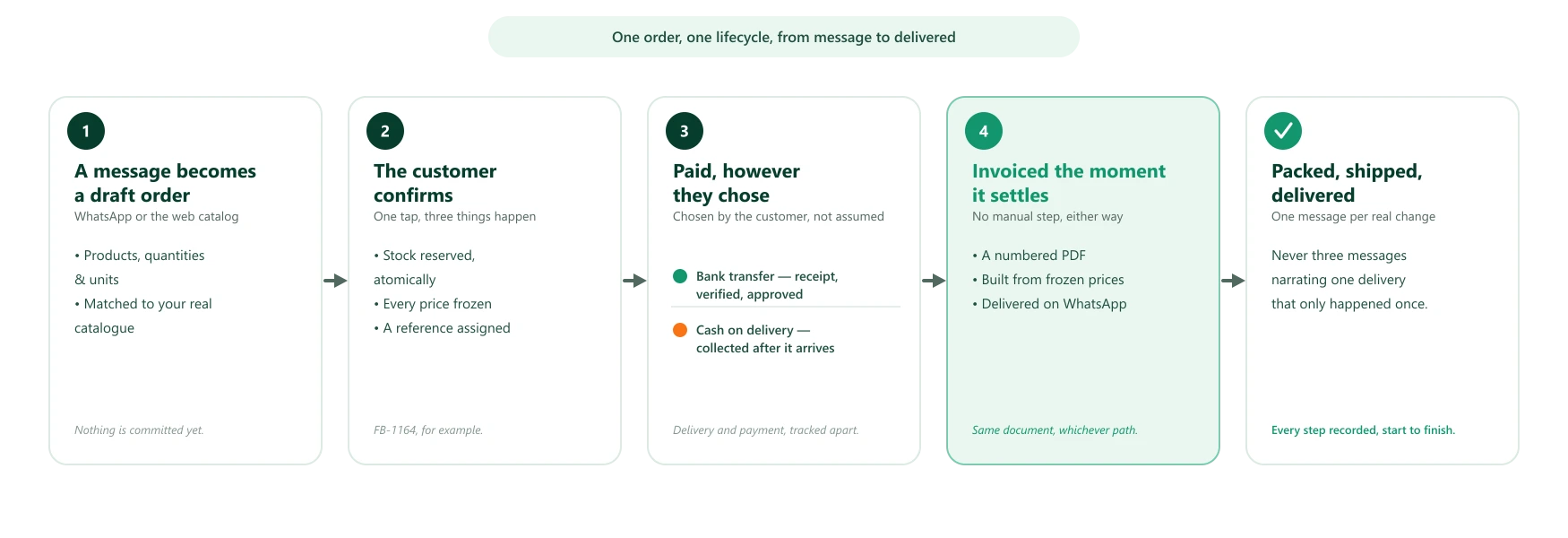
Understand the order
Retailers write orders the way they always have. OrderAgent turns the message into product, quantity and unit lines against your real catalogue, and the customer confirms the result themselves. Nothing is committed until they tap Confirm.
Lock the stock and the price
At Confirm, stock is reserved and every line keeps the price it was ordered at, even if you reprice the product a minute later. If a line is short, the customer is told what's actually left rather than left to guess.
Collect and verify payment
Payment instructions go out with a deadline. A receipt sent on WhatsApp is read and checked, then lands in your queue as a single tap. The software assists; the approval is always yours.
Invoice, pack, deliver
A numbered invoice PDF goes out automatically, your team moves the order through packing and delivery, and the customer is told once per real change — or can simply ask where it is.
Relevant features
Only what actually applies here
Not the whole product — the parts of it an FMCG business actually uses.
WhatsApp Ordering
Retailers keep messaging the number they already have — no app, no login. A free-text message in English, Tamil, Malay or any mix becomes an itemised order, and “same as last time” rebuilds their real previous order from your records for them to confirm. Less retyping for them, and for you.
Learn more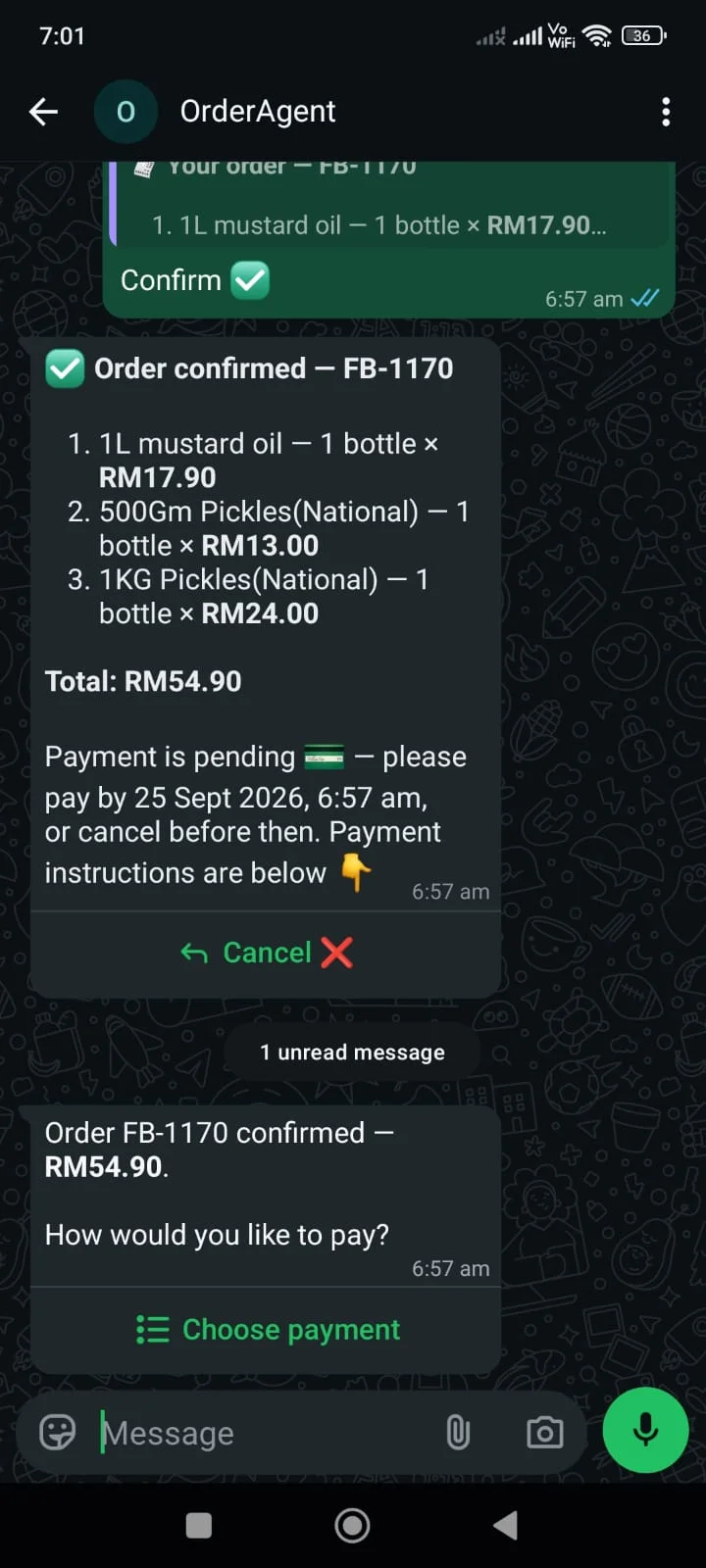
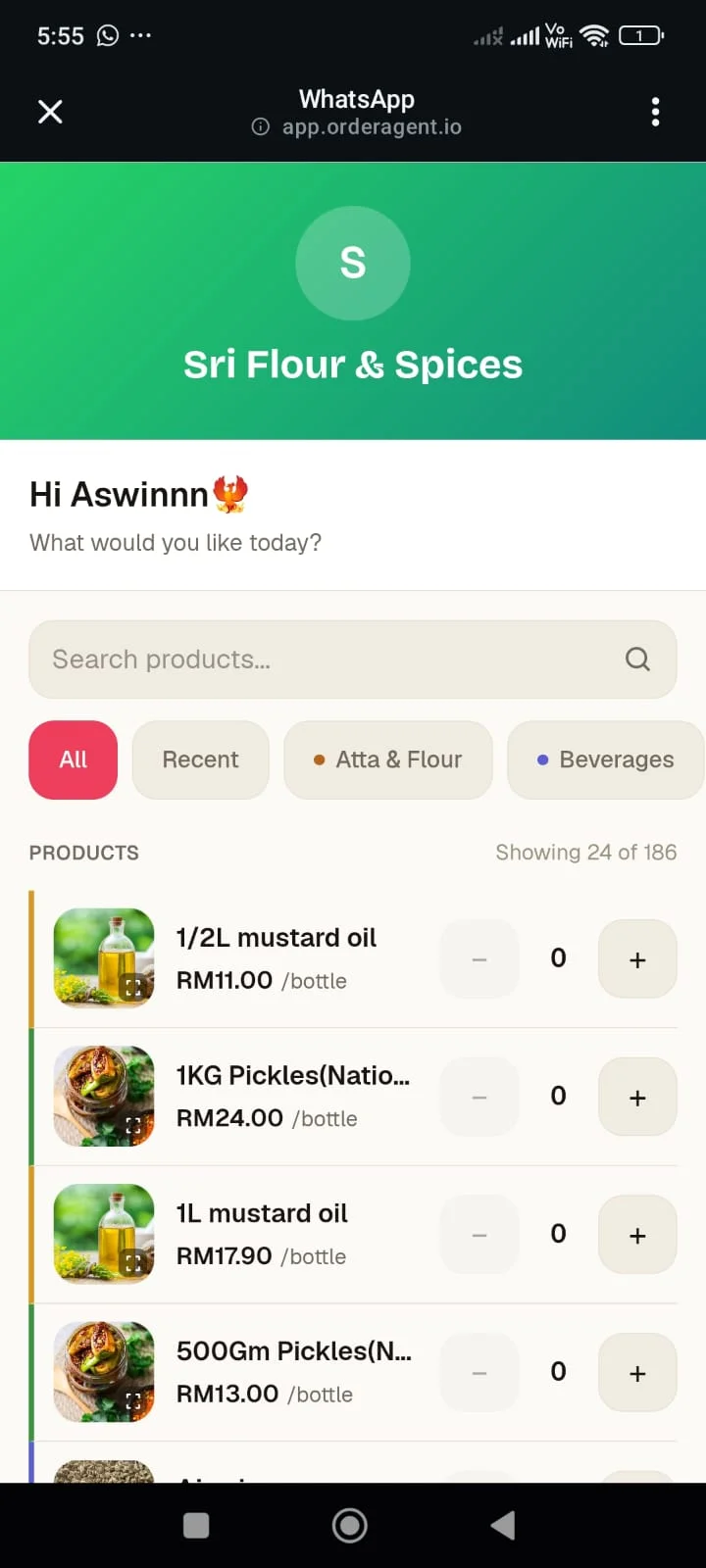
Large Catalogues
Hundreds of products, brands and pack sizes, read against your real catalogue and the aliases you've taught it — so “atta” finds “wheat flour”. Ask whether a product is available and the answer comes from the catalogue. Each retailer can also get their own secure link to browse it and send a cart straight into WhatsApp.
Learn morePayments
Payment instructions go out the moment an order is confirmed — the QR, the bank details and a deadline. The retailer sends a receipt on WhatsApp, and it's checked for amount, reference, date, currency, recipient and duplicates before it reaches you. The check assists; approving is one tap, and always yours.
Learn more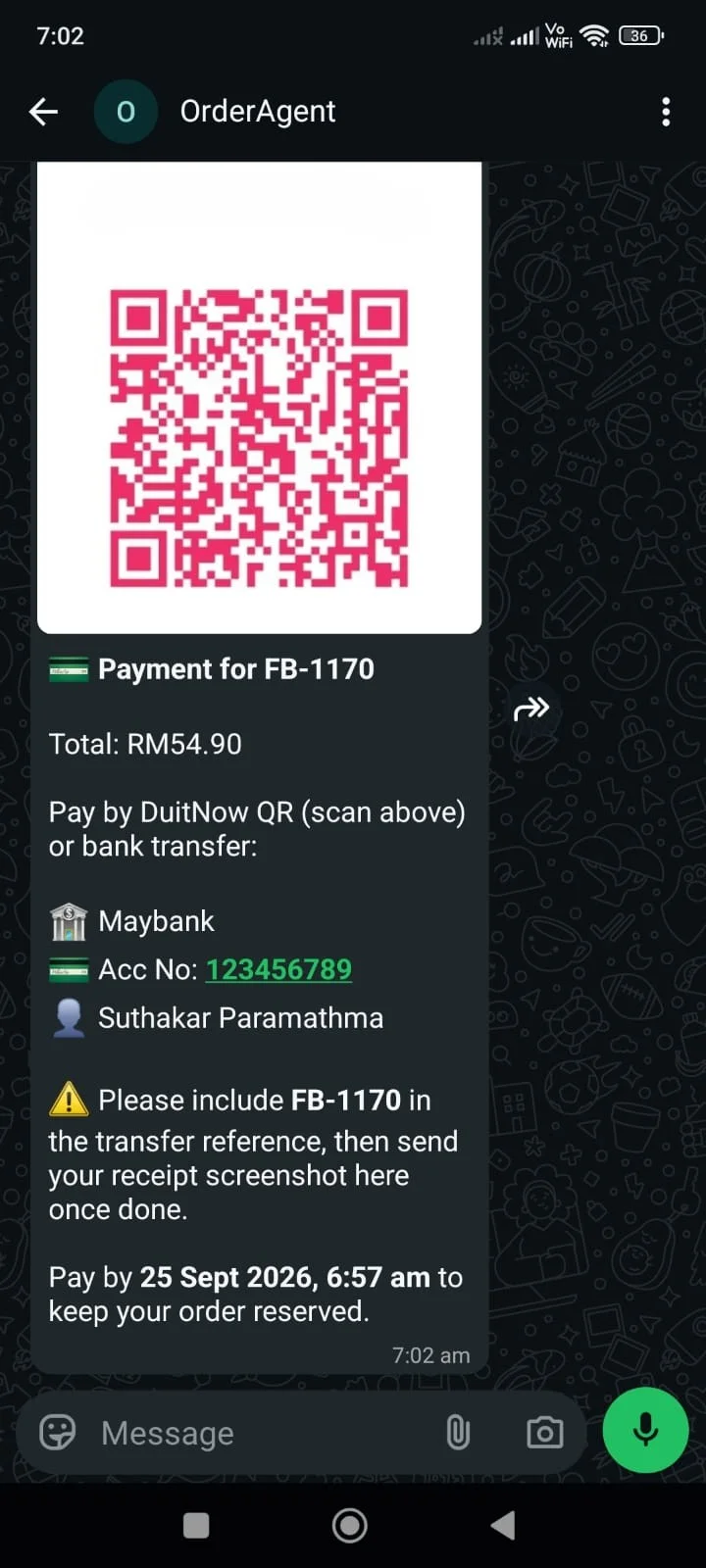
Invoices & Fulfilment
A numbered PDF invoice is generated from the order and sent over WhatsApp — nothing entered twice. From there PACK, SHIP and DELIVERED move the order out the door, and a retailer can ask “has my order been delivered?” and get the answer from the order itself.
Learn moreCustomer Profiles & Tags
Every retailer who messages you gets a profile automatically — orders, purchase history, saved address and payment history in one place. Tag them however you segment your book: retailers, restaurants, wholesale, high-value.
Learn more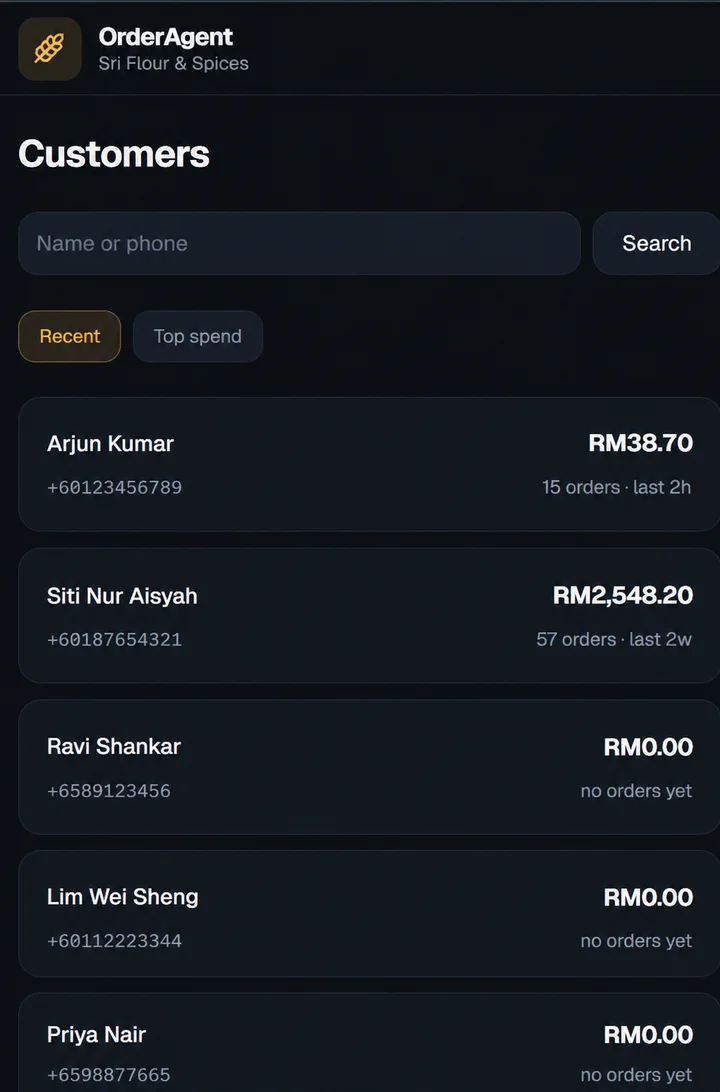
Campaigns
A new product, a bulk offer, a price change — sent as a real campaign to the customers it's for: a tag, people who bought a specific product, those who ordered recently, or those who haven't ordered lately. You see the recipient count before you send.
Learn moreSales & Revenue
What sold, how much, what's growing, what isn't moving and what needs attention — all from one definition of a sale, so a number never means something different on the next screen.
Learn moreA normal weekly order, start to finish
A retailer who orders every week sends: “20 cartons cooking oil, 10 cartons sugar, 5 boxes tea pls.” OrderAgent knows which customer it is, matches each line against the catalogue, and replies with a draft order — three lines and a running total.
They tap Confirm. Stock is reserved on the spot, each line keeps the price it was ordered at, and payment instructions go out with a deadline and the order's own reference.
They pay and send a receipt on WhatsApp. It's read and checked against the order — amount, reference, date, recipient — and reaches the owner as one tap: approve.
Once it's approved, a numbered invoice goes out on WhatsApp. The warehouse packs the order, it goes out for delivery, and the retailer gets one message for each real step.
Next week they send four words: “Same as last time.” The cycle starts again, with nothing retyped.
What changes
From scattered conversations to one connected workflow
ChallengeOrders arrive through WhatsApp
OrderAgentStructured WhatsApp ordering, confirmed by the customer
ChallengeCustomers use different product names
OrderAgentAI-assisted matching against your catalogue and aliases — a question instead of a guess
ChallengeLots of repeat orders
OrderAgent“Same as last time” rebuilds the previous order
ChallengeMany SKUs
OrderAgentCatalogue-aware ordering, plus a browsable shop link for each customer
ChallengeStock questions
OrderAgentAvailability answered from the catalogue; stock reserved at Confirm
ChallengeManual payment checking
OrderAgentReceipt reading and verification, with your one-tap approval
ChallengeManual invoice preparation
OrderAgentA numbered invoice generated automatically
Challenge“Where is my order?”
OrderAgentOrder status answered on WhatsApp
ChallengeA large customer base
OrderAgentCustomer profiles and tags
ChallengePromotions are hard to target
OrderAgentCustomer segmentation and targeted campaigns
ChallengeSales data is hard to see
OrderAgentA connected sales and revenue dashboard
Business benefits
What changes
Keep WhatsApp
Retailers keep ordering the way they already do — nothing new to install or learn.
Less manual order entry
Natural messages become structured orders, so nobody retypes the list.
Faster repeat orders
“Same as last time” rebuilds a previous order for the customer to confirm.
Orders, payments and invoices connected
An order doesn't stop at “received” — it carries on through payment, invoice and delivery.
Customer history stays connected
Orders, purchases, payments and conversations attach to the customer, not to a chat you scroll back through.
You stay in control
OrderAgent handles the repetitive work. Approving money, and the decisions that matter, stay with you.
Other business types
Turn every WhatsApp order into a connected business workflow.
From the first customer message to the final delivery, OrderAgent keeps your FMCG operation connected. It isn't a warehouse system or an ERP — it automates the customer-facing order and payment workflow, with WhatsApp at the centre.